Cutting a Doorway in a Concrete Wall: How Track Sawing Works
Wall sawing turns a solid concrete wall into a finished opening, and the prep you do decides how smoothly it goes.
October 13, 2026 · 4 min read
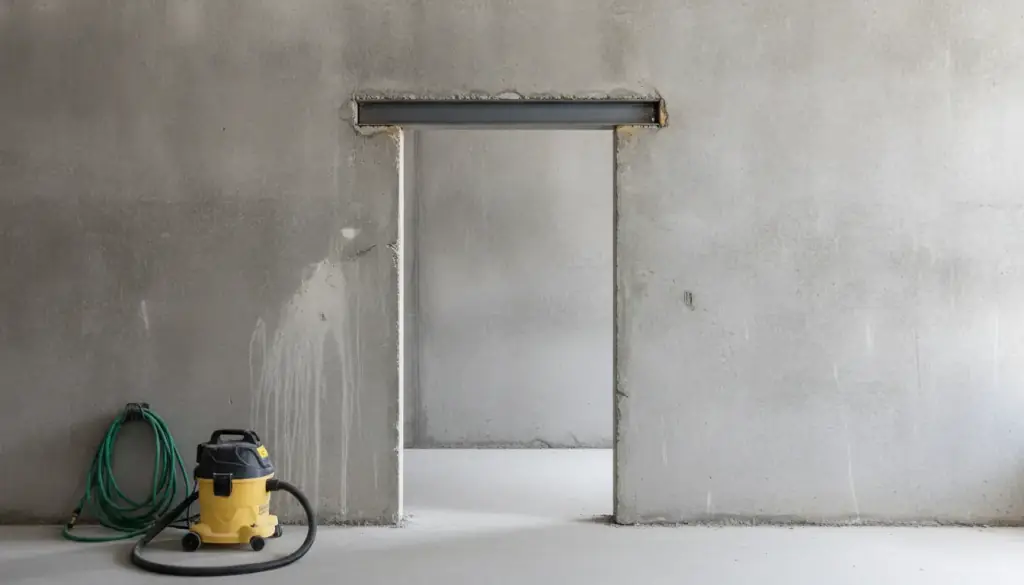
A concrete or brick wall doesn't have to stay closed. Doorways, windows, HVAC access and elevator shafts are often cut into walls that are already standing. The tool for that is a track-mounted wall saw, and understanding how it works helps you plan the opening, the supports and the cleanup before the first cut.
Most openings fall into one of four types: a doorway between two rooms, a window in a block or concrete wall, an opening for HVAC equipment, or the shaft for an elevator. Each has the same basic cut, four sides in a rectangle, but each leaves a different mess behind it and needs different support around it.
How a track saw opens a wall
A wall saw rides on a rail that gets anchored to the wall along the line of the cut. The saw is hydraulic or electric, and the operator runs it with a remote, so they can stand where they can see the cut instead of right beside the blade. Water feeds the blade to cool it and keep dust down, which is why wall sawing leaves a wet slurry that needs a plan. Osborn Concrete Cutting runs track-mounted hydraulic and electric saws, remote-controlled.
Because the rail holds the blade on a fixed line, the edges come out straight and square. That matters when a steel frame, a door jamb or a lintel has to fit the opening afterward. The saw also gets into small spaces where a larger machine won't go, such as a narrow room or a tight corridor. Osborn cuts brick, concrete, piers and pylons, in commercial and residential work.
Flush cuts and corners
Two things make wall sawing harder than it looks. The first is cutting flush. When an opening has to run right up to a floor slab or a perpendicular wall, the blade has to get close to that surface without damaging it. Osborn's track saws can cut flush with a slab or with a wall at a right angle.
The second is the corner. A round blade can't make a square inside corner on its own. Keep cutting until the corner is square and the blade overshoots, leaving a score line in the wall beyond the opening. These over-cuts leave marks past the edge, and they matter if the wall stays exposed or carries load, which is a question for your engineer. Cutters use methods to avoid over-cuts in corners, and it's reasonable to ask which ones they'll use on your wall.
Ask for a walk-through before the job. A cutter who looks at the wall in person can see the finish on each side, what's mounted to it and how much room there is for the rail. A drawing doesn't show any of that.
Cut-n-break corners for a lintel
Many openings get a lintel, the beam that carries the wall above the new opening. The top cut is where this gets interesting. The track saw runs the top cut long at each corner, past where the blade would otherwise stop, and a cut-n-break saw finishes the corner so the lintel can be installed. Osborn uses cut-n-break saws for exactly this step.
The lintel itself, its size, its bearing and any temporary support above the opening are your engineer's call. A cutter doesn't decide those, and shouldn't be asked to.
What the owner should prepare
- Mark the opening, with its width, height and height above the floor
- Confirm with your engineer or architect what supports and lintel the wall needs, before cutting starts
- Find out what runs through the wall, such as conduit, pipe or rebar, and what's behind it
- Clear furniture, equipment and stock from both sides of the wall
- Arrange water and power access, and decide where slurry can drain
- Plan how the cut-out section leaves the room, since it will be heavy
- Protect floors and finished surfaces nearby
Ask the cutter how big each section will be when it comes out, and who handles the lifting. Large pieces are usually cut into sections that can be moved, and the equipment to move them has to fit the space.
If people work on the other side of the wall, tell the cutter. Wet cutting keeps dust down, but a wall saw is still a working machine, and a heads up lets the crew plan around schedules, noise and foot traffic.
Osborn says it always leaves the work area clean and free of damage. Ask what that means on your site in particular, such as how slurry is collected and where floors get covered.
Osborn Concrete Cutting gives free estimates on wall sawing. Call (256) 489-7514, Monday to Friday, 7 AM to 5 PM. We're based at 828 Demasters Avenue NW in Huntsville and serve Alabama and surrounding states.
Osborn Concrete Cutting, (256) 489-7514
Call (256) 489-7514More articles
Core Drilling Through Concrete: What to Know Before You Book
A clean, round hole through concrete takes the right bit, the right size and a few details from you before the crew arrives.
Removing a Concrete Patio: Why Sawing Beats Breaking
Cutting a patio into liftable sections is quieter, neater and easier on everything around it than a day with a breaker.