Wire Sawing vs Blade Sawing: Picking the Right Tool
Blade saws are fast and precise, but when concrete is too big, too reinforced or too tight to reach, a diamond wire takes over.
October 13, 2026 · 3 min read
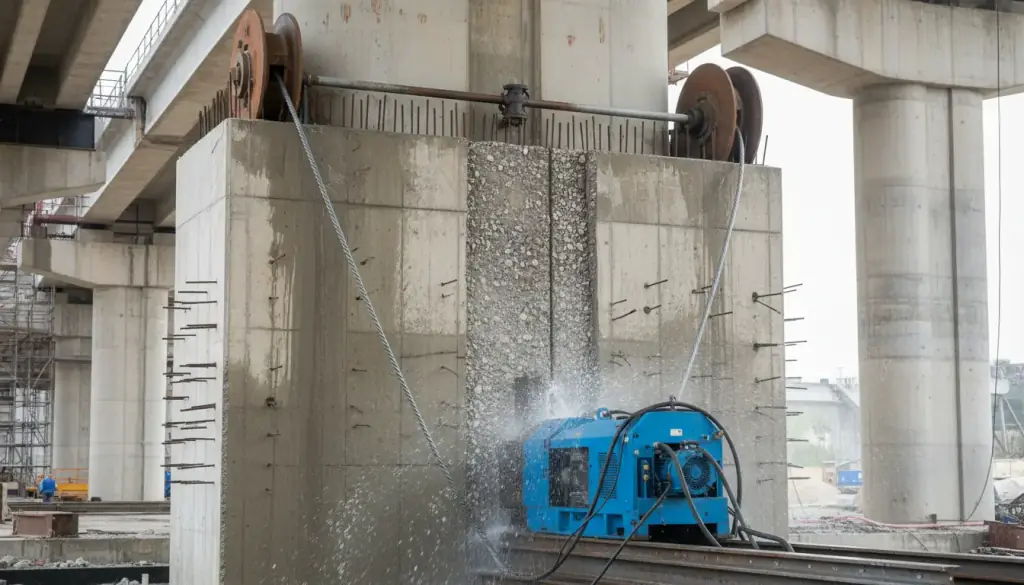
Most concrete cutting uses a circular blade. A blade saw is fast and precise, but it has limits. It needs room to swing, access to a face, and a cut that stays within the blade's reach. When the concrete is too thick, too reinforced or too awkward to reach, a diamond wire saw takes over.
How a wire saw works
A wire saw is a loop of steel cable threaded with diamond-infused beads. The loop wraps around or through the piece being cut, runs over guide pulleys, and is pulled by a drive unit. The wire cuts by abrasion, grinding through concrete and steel as it travels. Water cools it and flushes the slurry out. Nothing about the process depends on blade diameter, so the size of the piece matters far less than it does with a blade saw.
Because the wire can be routed around a piece and pulled in any direction, it can cut any part in any direction. Osborn Concrete Cutting uses wire sawing for material that's too strong, too large, or in a workspace too confined for a conventional saw, and to segment and remove large chunks of reinforced concrete.
Where wire sawing is the right call
- Steel-encased concrete, where the casing has to be cut along with the concrete
- Concrete retaining walls
- Heavily reinforced sections with dense rebar
- Large piers and other massive sections
- Confined spaces where there's no room for a conventional saw
- Underwater cutting and other challenging environments
That list follows the kind of work Osborn describes: steel-encased concrete, concrete retaining walls and reinforced rebar are named strengths of wire sawing, and underwater is one of the challenging environments it mentions.
In a confined space, the drive unit can often sit in the open area while the wire runs through the tight spot. That's why a workspace that stops a conventional saw doesn't always stop wire.
Compare it with the alternatives. Breaking a massive pier apart with a hammer is loud, shakes the surroundings and scatters debris, and a blade saw may not reach all the way through it. Wire cuts in controlled segments you can plan, label and lift.
A blade saw is still the better tool for a flat slab or a wall with open access to one face. Wire takes time to set up, since the wire has to be routed and the pulleys placed. It earns its place when the other methods can't do the job, or can't do it without side effects.
Low vibration, low noise
The quiet part is worth understanding. A wire saw cuts by steady abrasion, not impact, so it sends minimal vibration into the structure around the cut. It also runs with minimal noise compared to breaking. That matters next to occupied buildings, equipment that's sensitive to vibration, or old structures you don't want to rattle. Osborn lists minimal vibration and noise, and minimal environmental impact, among the benefits of wire sawing.
Minimal environmental impact is partly about what doesn't happen: no hammering, no scattered debris, less dust when cutting wet. The slurry still has to be handled properly, so ask where it goes.
Planning around the heavy part
Wire sawing usually cuts a large structure into pieces, and each piece has weight. Plan for that before the wire moves. How big the pieces are, how they're supported while the cut finishes, where they're lifted from and where they go next are lifting and structural questions. Your engineer, rigger or general contractor decides those. A cutter will help you split the structure along sensible lines, but the load path is not the cutter's call.
Access matters too. For the wire to wrap around a piece, the crew needs a path for it, and sometimes that means holes drilled for the wire to pass through. Osborn offers core drilling as well, which is worth mentioning if your job might need it.
Tell the cutter what the structure is, how thick it is, whether it's steel-encased, what's on the other side, and what has to survive the cut. A site visit is usually the only way to know whether wire is the right tool.
Osborn Concrete Cutting gives free estimates on wire sawing. Call (256) 489-7514, Monday to Friday, 7 AM to 5 PM. We're based at 828 Demasters Avenue NW in Huntsville and serve Alabama and surrounding states.
Osborn Concrete Cutting, (256) 489-7514
Call (256) 489-7514More articles
Core Drilling Through Concrete: What to Know Before You Book
A clean, round hole through concrete takes the right bit, the right size and a few details from you before the crew arrives.
Cutting a Doorway in a Concrete Wall: How Track Sawing Works
Wall sawing turns a solid concrete wall into a finished opening, and the prep you do decides how smoothly it goes.